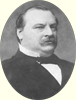
Good morning. I would like to thank everyone for coming today to the Annual Grover Cleveland Lecture. I would especially like to thank Sharon Farrell for her friendship and encouragement over these last few years. I have learned so much from working with her. I would also like to thank David Cowell and the GCBMA for inviting me to give this presentation.
Ever since I started volunteering at the Birthplace, I was fascinated by Grover Cleveland’s life--in and out of politics. Over the years, I have done research on many issues. In my first research project about Cleveland’s ancestry, I learned that Cleveland’s great-grandfather, Aaron, was a strong supporter of the American Revolution, served one term in the Connecticut legislature, and there introduced the first bill for the abolition of slavery in the State. And more recently, while reading a biography of Whitaker Chambers, by Sam Tannenhaus--Chambers was the former, Communist spy who turned in Alger Hiss--I discovered that Chambers’ attorney was Richard Cleveland, Grover Cleveland’s eldest son and a prominent Baltimore attorney. Richard Cleveland had been mentioned as a possible Democratic vice presidential candidate, but because Cleveland had opposed FDR’s re-election, this likely ended his political future.
During the many tours I have given at the site, the most frequent question I’ve been asked is: “How did Grover Cleveland go from being an attorney in a small town to president after only 3 years?” This is my attempt to answer that question. While there is so much to talk about when discussing the career of a successful president, today I will concentrate on his major accomplishments as Mayor of Buffalo and Governor of New York; and then I will briefly discuss the 1884 election which brought him to the White House. I would also like to add that I don’t hold myself out as a professional historian or an expert on Grover Cleveland; I am merely a retired attorney who has found something better to do with his time.
So how did Grover Cleveland become, in the span of just three years, the Mayor of Buffalo, the Governor of New York and the President of the U.S? The story starts in Buffalo.
II. MAYOR
A. Nomination
Grover Cleveland moved to Buffalo when he was a young man. He had initially decided to move to Cleveland but he had no money and no prospect for a job. Fortunately, he stopped in Buffalo to visit his uncle, Lewis F. Allen, who convinced him to stay and arranged for him to clerk at a local law firm. The arrangement worked out very well and Cleveland would eventually become an attorney and was admitted to the New York State bar in 1859. He would later become an Assistant District Attorney and then was elected to a two-year term as Sheriff of Erie County. He then quit politics for a few years and entered into the private practice of law.
As the 1870’s closed in Buffalo, there was general and rising discontent with the city government, which had fallen into the hands of an aldermanic
ring, which Samuel J. Tilden, the former Governor of New York and Democratic nominee for president in 1876) defined as
“a combination of corrupt politicians of both parties.” After a succession of ineffective mayors who cow-towed to these politicians, the citizens of Buffalo decided it was time to elect an aggressively honest man who would stand up to the ring. Their hopes were dashed when the Republican leaders, in 1881, announced they were going to nominate Milton Beebe for mayor. He was the president of the common council and it was obvious he was not going to buck the system. In other words, he was owned by the political machine and would be answerable to the people who got him elected rather than the citizens of Buffalo.
As soon as Beebe’s name was announced, many Republicans rose in open rebellion and bolted from the party. It became evident that the Democrats had only to name a reform candidate and they would win the support of these unhappy Republicans.
However, Cleveland was not sure that he wanted to run for mayor. The local Democratic Committee went looking for Cleveland and found him in court, arguing a case before Judge Albert Haight. Judge Haight has described what followed:
The Committee came into the court and attracted the attention of Mr. Cleveland. He came up to my desk, leaning his elbows on it, and talking in low tones. “This,” he said, indicating with a nod, “is a committee from the Democratic city convention, and they want to nominate me for mayor. They’ve come to see if I’ll accept. What shall I do about it?”
“I think you had better accept,” was Judge Haight’s reply. “The Republicans have gotten into a tangle. A good many are dissatisfied with the candidate nominated. Your chances may be pretty good.”
“But I’m practicing law and don’t want it interfered with,” objected Cleveland.
“The mayoralty is an honorable position,” urged Judge Haight. “We are all interested in having a good city government. You’re an old bachelor. You haven’t any family to take care of. I’d advise you to accept it.
And Cleveland did accept. He then appeared in the hall of the convention for a brief address:
“I hoped that your choice might fall upon some other and worthier member of the city Democracy. But because I am a Democrat, and because I think no one has a right, at this time of all others, to consult his own inclinations as against the call of his party and fellow citizens, I accept the nomination tendered to me.”
Then Cleveland introduced the idea of running the government like a business:
There is no reason why the affairs of our city should not be managed with the same care and the same economy as private interests. And when we consider that public officials are the trustees of the people, and hold their places and exercise their powers for the benefit of the people, there should be no higher inducement to a faithful and honest discharge of a public duty.
In the two weeks following his nomination, Cleveland was busy making speeches, and they shed light upon his character. The speeches were not eloquent or witty; they presented no constructive programs for city affairs. Their mandate was simply that the government must be honest and efficient. In the tumultuous atmosphere of New York politics in the 1880’s, this was a refreshing voice.
Cleveland made it clear that he didn’t like dishonesty in either party.
“A Democratic thief is just as bad as a Republican thief,”
he would say. “Why,” he demanded, “should not public interests be conducted in the same excellent manner as private interests?” He attacked the Republican county government which was then in control, and especially the system by which the county treasurer was allowed to pocket the interest on public monies of which he was the custodian. It was another example of politicians taking advantage of their positions for personal financial gain and it was just this sort of thing that Cleveland railed against.
“It is a good thing,” he told a rally of supporters,
“for the people now and then to rise up and let the officeholders know that they are responsible to the masses.” Subsequently, he revealed that he was and would always be fiscally conservative:
“We believe in the principle of economy of the people’s money, and that when a man in office lays out a dollar in extravagance, he acts immorally by the people.” In this remark we can see the influence of Cleveland’s religious upbringing; spending too much money was not just poor judgment, but it was immoral.
Because not much was known about Cleveland’s personal life, speakers were at a loss for material to attack him. The chief Republican newspaper, the
Buffalo Commercial Advertiser, critiqued Cleveland as “a wealthy old bachelor who is pretty well thought of” and found nothing worse to allege than
“he carries his head so high, as a rule, that he cannot see ordinary persons."
Another example of Cleveland insisting on doing things his way, he refused to spend money treating voters in the saloons, or to do any personal soliciting for votes. It worked: Cleveland won the election--he received more than 15,000 votes to Beebe’s 11,000 votes, which was a significant victory, considering that the Republican state ticket carried Buffalo by a decisive margin. All the circumstances of the election gave Cleveland a position of unusual authority. He didn’t owe his victory to any one person or party organization.
This is a foreshadowing of his future political successes; he would often win votes from Republicans and independents, which he would desperately need, especially since he was always at war with the political machines of his own party.
B. Accomplishments as Mayor
of Buffalo
Cleveland was sworn in on January 1, 1882. As mayor, Cleveland would be known for two significant accomplishments—both in the nature of a fight against the existing power structure, the Buffalo Ring previously mentioned. The Ring thought they would have an easy time controlling this political novice; they would find out much to their displeasure how wrong they were.
The first confrontation concerned the street cleaning contract; the second, the construction of the sewer system. In addition to these two major conflicts, he was also vetoing numerous petty bits of graft which the alderman and certain well-connected local contractors, were trying to sneak past him. This was the beginning of his career as a veto politician. During his first term as president, Cleveland would veto more bills than all the presidents before him—combined.
As for the street-cleaning controversy, it started in June, 1882, when the city council awarded a contract to clean the paved streets and alleys of the city for the next 5 years to a local contractor for more than $425,000, even though there were five other bids that were lower. To make matters worse, the contractor’s bid was initially $372,000; but he raised it by 50,000, in a blatant attempt to show the aldermen that this extra money would find its way into their pockets, if only they would vote in his favor.
The Aldermen gave various, flimsy, excuses as to why they accepted the highest bid; Cleveland’s veto, while scolding the alderman for their lack of integrity, quickly disposed of these hollow excuses:
This is a time for plain speech, and my objection to the action of your honorable body, now under consideration, shall be plainly stated. I withhold my assent from the same, because I regard it as the culmination of a most bare-faced, impudent, and shameless scheme to betray the interests of the people, and worse to squander the public money. . .
Initially, the vote by the aldermen was 15 to 11 in favor of the highest bid; After Cleveland’s veto, they rescinded their action by a vote of 23 to 2. Cleveland showed himself to be a shrewd and convincing executive.
The Buffalo Courier proudly proclaimed: “Rarely have we heard such a universal and unanimous round of public applause as that which everywhere yesterday greeted Mayor Cleveland’s message.” The contract went to a lower bid that saved the city more than
$100,000.
The issue of sewer construction doesn’t sound terribly interesting or controversial. Today, of course, we take these municipal services for granted. But back in the 1880’s, very few cities had yet constructed sewer systems. New York City built its system only after the Civil War; smaller cities like Philadelphia and Chicago had been draining their untreated sewage into nearby lakes and rivers, advising their citizens to boil their water.
Buffalo was by no means exceptional therefore, in letting this problem go unsolved year after year. But by the beginning of the 1880’s, the problem had become a crisis. The Erie Canal intercepted the natural flow of water from the city of Buffalo to Lake Erie. As a result, the sewage of a large section of the city passed directly into the canal where it baked in the sun. The canal had become a great brewing vat for disease.
According to Cleveland, it would be money well spent to construct the sewers and he wanted the
“best available engineering skill” to plan and supervise its execution. Most people wanted the sewer built; that wasn’t the controversy. But by whom and who would supervise the work? Cleveland is not noted for his creative thoughts or plans; but here, he came up with a novel idea. He suggested that the city ask the legislature to create a commission of citizens, to have full control of the construction until it was completed. Cleveland went on to explain that the work would be the most expensive and complex in the history of Buffalo; that the city council and city engineer were too busy with routine affairs to give it the necessary attention, and that:
“It does no harm to bring the non-office-holding portion of the community into [the project].
Upon hearing that they hadn’t been included in Cleveland’s plans, the politicians rose in open revolt. They were against the idea of a commission to oversee the project because it would get in the way of their handing out meaningless jobs, skimming money off the top, and delaying the project in an effort to force concessions from the new mayor. Nevertheless, the bill for creating the commission was introduced in accordance with Cleveland’s wishes. The aldermen were not convinced, however, and passed a resolution condemning it and requesting its withdrawal. Newspapers rallied with unanimity behind Cleveland, and public sentiment followed.
The commission proposed by Cleveland met with the best sanitary engineers of the country, and adopted a plan that met all requirements at a cost of $750,000, less than half of the lowest original bid; Cleveland saved the city almost three quarters of a million dollars, and thereby prevented this money from lining the pockets of the Ring.
These two conflicts between the political machine and the novice mayor were both resolved in June, 1882, the same month, coincidentally, that the convention for Governor of New York was being held. He was no longer just a local figure. What caught the attention and admiration of the public and other politicians was the way that he stood up to the private and public interests which, up to this point, had controlled the city.
It would have been easy for Cleveland to have signed these bills. But he had a strong sense of right and wrong; he was doing what he had promised: running the government like a business, not a charity. He became known as the Veto Mayor who was willing to stand against the tide of the established interests. Cleveland would later famously remark, about his sobriquet—the Veto
Mayor—“I ought to have a monument over me when I die—not for anything I have done but for the foolishness I have put a stop to.”
III. GOVERNOR
A.
Path to Governorship
Cleveland’s next challenge would be in Albany. According to Nevins,
“[t]here were doubtless hundreds of mayors in the United States in 1882 who served competently and incorruptibly, and there were doubtless many who showed the same kind of courage as Cleveland.” So how was it that Cleveland was able to jump from small town mayor to possible democratic nominee for Governor? Nevins concludes that:
“The answer is simply that circumstances favored him. All his common sense, his superb courage, his physical and mental strength, his cautious sagacity, would have availed him little but that the stars were with him.”
In other words, it was a matter of luck and most importantly, timing. It is hard to disagree with Nevins. In politics, timing
is everything. In the 1880’s, the New York Governor’s term was three years. It just so happened that the election would be held in November, 1882, only a few months after Cleveland’s well-publicized battle with his city council. The news of the Veto Mayor of Buffalo was just starting to spread to the far reaches of New York State.
Now that Cleveland was seeking the governorship, he would have to deal with many more political organizations. The most powerful and at times the most corrupt of these was the Democratic machine called Tammany Hall. While Tammany Hall also performed a legitimate function in city and state politics, its name had become synonymous with corruption--from paying graft, to providing patronage, to buying and controlling votes in the legislature, and finally, to bilking the government out of millions of dollars. And it played a prominent part in the rise of Cleveland’s career.
A witness to the rampant corruption in New York State politics during this time was Theodore Roosevelt, who started his career in the New York State legislature. In 1885, Roosevelt wrote an article in which he described how corrupt the Assembly was:
In the 3 legislatures of which I have been a member, I have sat with bankers and bricklayers, with merchants and mechanics, with lawyers, saloon keepers, clergymen, and prizefighters. Among my colleagues there were many very good men; there was a still more numerous class of men who were neither very good or very bad, but went one way or the other, according to the strength of the various conflicting influences acting upon them; and finally, there were many very bad men.
This, then, accurately describes the political scene into which Grover Cleveland was moving—from Buffalo to Albany; once again, corruption was the norm and Cleveland’s dedication to honor, hard work, and his strong sense of public duty, would enable him to stand out among the crowd and succeed beyond anyone’s wildest imagination.
Before he entered the picture, the Democratic nomination for New York Governor was a 2 man race: Roswell Flower of Watertown, New York, and General Henry W. Slocum, from Brooklyn. Flower had served a term in congress, was a wealthy financier, and had lots of money to spend on campaigning. Slocum was a general in the Union army, and was the leader of one of the wings of Sherman’s famous March through Atlanta to the sea, which hastened the defeat of the Confederacy.
How could Cleveland possibly compete with a seasoned and wealthy politician or a much decorated General of the Union army? The answer would be the very political organizations who were usually Cleveland’s enemies. In New York State at this time, the two most significant political machines were the Tilden organization and Tammany Hall.
The Tilden organization was named after the prior New York governor, Samuel J. Tilden, who lost the 1876 presidential election to Republican, Rutherford B. Hayes. This machine was run by Daniel Manning, who would become an important catalyst in Cleveland’s career (Cleveland would appoint him as Secretary of the Treasury in his first administration). In the beginning, the Tilden organization backed Henry Slocum.
The second influential political machine was Tammany Hall, which was run by its boss, John Kelly. Kelly would become Cleveland’s nemesis while he was governor and, again, during his run for the presidency. At the outset, Tammany Hall didn’t back either of the two main candidates; instead, it intended to divide its votes until victory was in sight, and then swing its votes to the winner, thereby appearing to be instrumental in helping the candidate win. Kelly would then be in a position to demand patronage jobs which would be divvied up among Tammany’s politically hungry members.
The bottom line for Cleveland, however, was that there was no clear cut candidate. The situation called for a new face—a strong and independent politician who didn’t have any ties to the existing machines. Into the New York political scene walked Edgar Apgar, of Albany, a talented orator and political organizer. All admirers of Cleveland have reason to remember his name with gratitude.
Apgar was not happy with the slate of candidates for Governorship; he was in the habit of reading newspapers from all over the state and had read about the infamous “veto mayor” of Buffalo. A friend of Apgar’s recounts an anecdote that illustrates Cleveland’s special appeal at that time.
One evening Apgar came in with a rapid step and illuminated face which at once indicated to me that he had something new and important to tell me. He asked me if I knew Grover Cleveland of Buffalo. I answered that I did not. He said that he had just been reading in a Buffalo paper, a message that Cleveland had just sent to the Buffalo common council, vetoing the street-cleaning job, and which contained sentiments which could only come from an ugly-honest man of good purposes and undaunted courage, and that to his mind… Cleveland would make a good candidate for governor.
This was the beginning. Cleveland was studied and watched, and the young men of the various party organizations rallied around
Apgar.
Cleveland had initially wanted to become a New York State Supreme Court Judge; however, he quickly came to realize that the nomination for governor would be a far greater prize. While Cleveland was dreaming about his political future, reality came bursting through; his mother became gravely ill. She lingered for several months before passing on July 19, 1882. It was a devastating loss for him; his father had died when he was only 16—which cut short his plans for college, and which left him partially responsible for the care of his mother and younger siblings.
Cleveland had always been very close to his mother, and would often remark in letters to his siblings how much he wished that his mother had lived to see him become president; and that he loved hearing that he was in his mother’s prayers.
By August, Apgar wrote Mayor Cleveland, offering his help and suggesting that Cleveland pay a visit to Daniel Manning. Cleveland decided it would be best not to visit Manning, otherwise it would look like he was being supported by the Tilden organization; it would fly in the face of the image he wanted to portray—that of being independent of New York’s political machines.
As Cleveland later acknowledged:
I am entirely certain that if there is anything of my candidacy, it rests upon the fact that my location, and an entire freedom from the influence of all and every kind of factional disturbance, might make me an available candidate. If my name is presented to the Convention, I should think it would be presented upon that theory.
The Democratic State Convention met in Syracuse in September, 1882. Cleveland had been mayor for less than nine months. At the beginning of the convention, it was widely known that Flower and Slocum were tied; Cleveland had already risen to third place.
Then a bombshell hit. It was at that time that the Republicans shot themselves in the foot. The incumbent New York Governor was Republican Alonzo B. Cornell. He was the son of the founder of Cornell University; he had been the chairman of the New York State Republican party; and he was chosen as the Speaker of the state assembly after only one term in office. Notwithstanding Cornell’s appeal, the New York Republican machine gave in to pressure from then President Chester Arthur, who had been a powerful player in New York politics and patronage. Instead of nominating the incumbent governor, Cornell, the machine replaced him with Arthur’s Secretary of the Treasury, Charles J. Folger. Immediately, independent voters rebelled. Once again, they complained that New York politics was subservient to the power of the purse and patronage, and that the politicians were ignoring the wishes of ordinary citizen; and this would open the door for Cleveland to walk right through.
Cleveland took a train to Syracuse and held an informal meeting in the lobby of one of the hotels. And since it was the eve of the convention, he decided it was finally time to meet with Manning; he knew he could not succeed without the help and backing of this powerful insider.
At the convention, both Slocum and Flower were nominated. Then Edgar Apgar walked to the podium to nominate Cleveland. According to the
Buffalo Commercial Advertiser, he was lifted to a level of emotion unusual even for him. Beginning with forced calmness, he pointed out the dangers of choosing either Slocum or Flower because they were from the two great hostile factions of the state democracy. Apgar launched into a glowing speech about Cleveland, pointing out his strength as a reformer and independent (two adjectives that would often be used to advance his political career). Apgar’s eloquence produced a clear impression; when he finished, he received a lengthy applause. According to Nevins, Apgar
“had achieved that rare result in political conventions—he had changed votes.”
After two ballots, the two main candidates were still deadlocked; at this point, Manning, on behalf of the Tilden organization, swung its votes to Cleveland; then the other political organizations followed his lead and switched their votes to him. Cleveland won the nomination without incurring any political debts of importance; his primary obligation was to his friends in western New York. Buffalo celebrated his nomination with much fanfare.
Because of the split among the Republicans—nominating Folger instead of the popular incumbent, Cornell, the election was already assured for Cleveland. The split in the Republican Party had forged the final link in the chain of circumstances which was to make Cleveland the governor by the largest margin of victory to date.
According to most political pundits of the day, had Cleveland been a weak candidate instead of a strong one, the result still would have been the same. Cleveland, looking back twenty five years later, spoke of being a political novice, and defeating a nationally known candidate like
Folger:
To me, it seems the very irony of fate that a man of this type, with a career distinguished by conspicuous and honorable service, and of such unusual capabilities, well known to the public, should have been defeated by me, then wholly unknown outside my own small community. I must confess that, even now, a quarter century after the event, I am unable to understand it…
Cleveland then wrote a letter to his brother William, revealing how uncertain he felt about his own abilities; “The thought that has troubled me is, Can I well perform my duties, and in such a manner as to do some good to the people of the State? I know there is room for it, and I know that I am honest and sincere in the desire to do well, but the question is whether I know enough to accomplish what I desire.” He ended the letter with a reference to his mother;
“Do you know that if mother were alive I should feel so much safer? I have always thought her prayers had much to do with my success. I shall expect you to help me in that way.”
B.
Accomplishments as Governor
Cleveland was sworn in as Governor on January 1, 1883. His first act was largely symbolic. He at once threw open the doors of his office to all comers, transacting business virtually in public. Some said that the executive chamber took on the appearance of a town meeting; the Lieutenant Governor, David P. Hill, (later to become governor of New York) suggested that the governor
“might as well place his desk on the grass in front of the capitol building; he would be no harder to approach and he would have the advantage of the fresh air.”
It was at this time that Daniel Lamont entered Cleveland’s life; Lamont proved indispensable, especially since Cleveland was not good at delegating work. Lamont, who had been a shrewd political reporter, became Cleveland’s loyal, private secretary and a good friend—he would become Secretary of War in Cleveland’s second term. In fact Lamont’s professional and personal relationship with Cleveland had become so well known that 50 years later, Franklin D. Roosevelt would turn to his aide Jim Farley and say;
“I have an idea that you and I make a combination which has not existed since Cleveland and Lamont.”
Cleveland’s initial test as governor had to do with his political appointments—(again, foreshadowing the battles he would have during his first term as president and his success with the repeal of the Tenure of Office Act). He continued to appoint men according to their merit rather than the wishes of the various political machines; and they fought back, tooth and nail. He owed his success to the fact that he wasn’t beholden to any political organization; and he had already made it clear that he had no intentions of running for re-election. Tammany Hall and the other political machines had nothing as yet to hold over his head.
Just as Cleveland became famous in Buffalo as the Veto Mayor, he would similarly become known as the
Veto Governor. While this may sound like a negative, it must be seen in its proper historical context, as the battle for power, at all levels of government, between executives and legislatures. According to Geoffrey Blodgett, a former political science professor at Oberlin College, and a well-respected expert on Grover Cleveland;
The spoils system had sucked power everywhere from presidents, governors, and mayors into the hands of legislators. And Cleveland: “turned the veto authority of his office into a spectacular weapon of prevention. Time and again his vetoes of legislative squandering brought a halt to normal habits, forced embarrassed politicians into self-restraint and made headlines.
Cleveland's most famous veto as governor was that of the five cent fare for the elevated railroad. The elevated railroad in New York City had proved very successful. By 1883, Jay Gould was in control, and everyone hated him because it was pretty well understood that he was stealing money.
Soon, because the elevated railroad had become so popular, demand was to reduce the fare. At the time, the fare was a nickel at rush hour and ten cents at other times; the popular cry was to lower the fare to a nickel at all times. The bill easily passed both houses. In the senate, the fight was led by Thomas Grady, who was the personal representative of Boss Kelly of Tammany hall. After hearing Grady describe the bill as a measure for justice, the bill passed in the senate by a vote of 24 -5.
The bill was actually intended to punish Jay Gould. According to its backers, no one could deny that his company had used trickery to conceal its profits and evade its due share of taxes. Most local newspapers were in favor of the bill.
The governor could easily have signed the bill, accepted hearty congratulations, and let the courts decide its constitutionality. As he sent the veto message to the legislature, he remarked to himself;
"By tomorrow at this time I shall be the most unpopular man in the State of New York.”
Then he describes what happened the next morning;
I didn't look at the morning papers; I didn't think that they had anything to say that I cared to see. I went through my morning mail with my secretary, Dan Lamont, pretending all the time that I didn’t care about the papers, but thinking of them all the time, just the same. When we had finished I said as indifferently as I could,
‘Seen the morning papers, Dan?’
He said, ‘Yes,’
‘What have they got to say about me, anything?’
‘Why yes, they are all praising you.’
‘They are? Well here, let me see them. . .’
I tell you, I grabbed them pretty quickly and felt a good deal better.
Public opinion was clearly in favor of the reduced subway fare; however, the governor’s argument was the legally correct decision. In commenting on the veto Cleveland proclaimed;
The state should not only be strictly just, but scrupulously fair, and in its relations to the citizens every legal and moral consideration should be recognized. This can only be done by legislating without vindictiveness or prejudice, and with a firm determination to deal justly and fairly with those from whom we exact obedience.
The veto was received on March 1st, and Tammany members were livid. They quickly convened to see if they had enough votes to over-ride Cleveland's veto. But they had a problem. Many members, after hearing Cleveland's reasons for vetoing the bill, had decided to switch sides. Theodore Roosevelt was the first to rise in support of the veto. Full of admiration for Cleveland, T.R. admitted:
I have to say with shame that when I voted for this bill I did not act as I think I ought to have. . . I have to confess that I weakly yielded, partly to a vindictive spirit toward the infernal thieves [who run] the Elevated Railroad] and partly in answer to the popular voice of New York [‘s citizens].
Cleveland would later comment on T.R.’s youthful ways:
“There is great sense in a lot of what he says, but there is such a cocksureness about him that he stirs up doubt in me all the time. . . Then he seems to be so very young.”
Cleveland’s second important veto as Governor wiped out a bill for re-organizing Buffalo’s fire department, and which more importantly, indirectly destroyed Tammany's scheme for revising the New York City charter. The fire department bill was an attempt to create patronage in Cleveland’s old stomping grounds. The whole Democratic organization in Buffalo, including the newspaper, local officials, and state senator were all behind the measure. Clearly, Cleveland would have pleased his former friends and political allies by signing the bill; and when he decided he had to veto it, he should have shown more tact and told them what he was going to do. But Cleveland was not always the most tactful of politicians; when he felt he was doing right, that was the end of the story.
Instead of signing the bill, Cleveland struck it down with scorching language. According to a journalist in Buffalo, commenting on how Cleveland’s former colleagues had taken the news:
"The Democracy of Erie [County] is one white-hot hissing globule of rage. If the) made a mistake last November, the people didn't. Cleveland has shown himself what we took him on trust to be last fall--bigger and better than his party."
In addition to “running the government like a business” and saving the people’s money, Cleveland also wanted to bring about reform to state government—specifically, the harbor masters, who controlled traffic coming into New York harbor, and the Immigration commission. Both branches needed reform and both had offered fat pickings for Tammany Hall. As for the immigration commission, they had recently proved incompetent and dishonest, wasting more than 200,000 that was appropriated to them for the protection of new immigrants flooding into the city.
Regarding the harbor masters, Tammany was willing to cooperate with Cleveland and was ready to pass the necessary legislation, but in return, they insisted that part of the new patronage that would fall to the governor should be given directly to Tammany Hall.
Cleveland expressed his outrage at the deal that Tammany expected him to make;
"There began an astonishing pressure to secure a promise that the patronage of the office should be duly apportioned between the different political factions in the Senate, and that this promise should be a precondition to the confirmation of my appointees.”
Just before the last day of the session, Thomas Grady, Tammany’s representative, sent Cleveland a private note, begging him as a special favor to name a certain Bryan Reilly, a former alderman, as harbor-master.
"I hope that you will kindly make the appointment for me, as it will place me in a most humiliating position with my people here, if I, with so many appointments to be made, should fail in securing one of them for so good a man as Mr. Reilly.”
Grady could hardly believe his eyes when he saw that out of 300 places that would have come into the democratic hands through these nominations, Tammany was not guaranteed so much as a night watchman. Tammany Hall was enraged; it reacted by holding up Cleveland's entire list of nominations. Cleveland was angered but he defended his position. He had lost the battle, but he would eventually win the war.
Cleveland’s first six months in the governorship had demonstrated two conflicting results. It had given him excellent lessons for the Presidency, and it had produced a quarrel with Tammany, which, if not healed, would make his election to the Presidency highly improbable. No Democrat could be president without carrying New York State, and, no Democrat, barring a truly extraordinary conjunction of circumstances, could carry New York while bearing the full hatred of Tammany Hall.
Cleveland never hesitated in his open battle with Tammany. He had an attitude of instinctive and uncompromising hostility. In his eyes, Tammany was interfering with his honest work and was threatening him, and he brusquely thrust them aside.
Cleveland realized early on that if he wanted to enact legislation, he would need the cooperation of the Republicans—and for this he turned to TR. The alliance between the two future presidents began early in the session when Cleveland asked Roosevelt and other reform minded Republicans to his office to discuss the passage of a civil service reform bill which was tied up in the Judiciary Committee by a combination of Democratic and Republican spoils men. Cleveland promised Roosevelt that if he, as minority leader, could get the bill to the floor, Cleveland would mobilize the Democrats. TR lived up to his end of the bargain and the bill was eventually passed—dealing another blow to machine politics and patronage. It was the country’s first state civil service act.
Cleveland’s second year as Governor would present more challenges inasmuch as the Republicans now controlled the state legislature. However, Cleveland rose to the occasion and continued his working relationship with TR. According to Nevins,
“It was a happy conjunction of stars which brought together the two greatest men New York had produced since [John] Jay and [Alexander] Hamilton.” TR began drafting a broad set of reforms and worked with the governor to get the bills passed, notwithstanding the opposition from Cleveland’s party. In addition to these reform measures, Cleveland could claim credit for: securing passage of a law for the compulsory examination of all banks and trust companies; and the appropriation of almost $1.5 million for the preservation of the Niagara Falls region.
Cleveland proved himself to be a very hard worker, often laboring long into the night, just as he had done when he was a private attorney. In declining a dinner invitation towards the end of the legislative session, he wrote:
“I had my lunch brought to me, and have directed my dinner to be also brought, and with this economy of time, I am afraid the night will not be long enough to do all I have on hand. Need I say any more—except to assure you that ‘It’s fun to be governor?”
Once again, timing would prove to be in Cleveland’s favor. The term of the New York Assembly ended that year on May 16, 1884. Because Cleveland had thirty days to sign or veto bills presented to him, he worked night and day until the middle of June, the deadline for making his decision on these bills.
While he was toiling away, it was on June 3, that the Republicans in Chicago nominated James G. Blaine as their candidate. The Democratic convention was going to be held on July 8, only 3 weeks after Cleveland would complete his work for that legislative session. Because of Cleveland’s success in his two years as Governor—showing that he could both fight against the political machines
and work across party lines, he was now being mentioned as a possible presidential candidate.
IV. 1884 PRESIDENTIAL CAMPAIGN
Now we turn to the 1884 presidential campaign. At the Republican Convention in Chicago, Reverend Bristol delivered the invocation and thanked the Almighty for the Republican Party; he also prayed that
“the coming political campaign may be conducted with that decency, intelligence, patriotism and dignity of temper which becomes a free and intelligent people." His prayer went unanswered. Some said it was the vilest campaign ever waged. The magazine,
The Nation, lamented on October 23rd : "Party contests have never before reached so low a depth of degradation in this country." Henry Adams (the grandson of John Quincy Adams), wrote a friend in England:
"The public is angry and abusive. We are all swearing at each other like demons."
The Republicans nominated James G. Blaine. He was the most popular Republican of his generation. He had been Secretary of State for six months under Garfield until Garfield was assassinated; and he would later be named Secretary of State under Benjamin Harrison. When his name was put into nomination at Chicago, the effect was electric:
The New York Tribune reported: “Whole delegations mounted their chairs and led the cheering which instantly spread to the stage and deepened into a roar fully as deep and deafening as the voice of Niagara.”
But the reformers of the party were outraged. Blaine was suspected of crooked dealings with the railroads—and making millions of dollars while he was Speaker of the House of Representatives. Reformers bolted from the party and announced that they would support the Democratic nominee if he proved acceptable. They charged that Blaine:
"Wallowed in spoils like a rhinoceros in an African pool."
As for the Democrats, there were of course many more likely candidates than the novice, Cleveland. In retrospect, Cleveland didn’t have the two prerequisites that all the other presidents would have from U.S. Grant to TR—a college education and a successful military career; Grant, Hayes, Garfield and Harrison were all decorated generals in the Union Army; McKinley was a Major; and all graduated college, except for McKinley. Only Chester Arthur doesn’t fit into this category and he wasn’t
elected president, but instead was chosen as Garfield’s Vice Presidential nominee and only became president upon Garfield’s assassination.
In fact, many people believed and expected that the party would turn to the “old ticket” of Tilden and Hendricks—if only because the election had been ‘stolen’ from them in 1876 by the Republicans. Because Tilden and Hendricks had garnered 250,000 more popular votes than Hayes, and because they had won 51% of the vote to the Republican’s 48%, it was believed that the ticket was still popular. There was some truth to that; however, unfortunately for Tilden, he had suffered several strokes since the last election and he was but a shell of his former self. When he spoke, people could barely hear him. In fact, a supporter who went to see him commented afterwards:
“I do not think he would look much worse if he were dead.” Hendricks had a chance at the head of the ticket especially since he was from Indiana --which was one of the three critical or battleground states--the other two being New York and Ohio. In those days, Democrats had to win at least one out of those three to win the election. But there was another popular politician from Indiana, Senator Joseph McDonald, and the last thing the convention could tolerate was a split in a state’s delegation—that could spell weakness for the national ticket.
Another well-respected potential nominee was Thomas Bayard, (who would become Cleveland’s Secretary of State in his first term). However, Bayard had two strikes against him; first, he was from Delaware, which only has three electoral votes, and therefore it wasn’t considered an important enough state. And second, at the beginning of the Civil War, Bayard had released a statement which was in favor of states’ rights and which implied that the federal government lacked the power to deal with secession. It wasn’t treason, but the Republicans would certainly treat it as such.
The person who was at the center of the New York delegation was Daniel Manning. Manning got his start as a messenger and copy boy for the Albany Argus, the official upstate New York party newspaper. He worked his way up to editor, and thanks to Tilden, was made the chairman of the state democratic party. If Tilden were healthy, he would have no choice but to defer to him; however, due to Tilden’s failing health, Manning was in a perfect position to bring someone else along—and that was Cleveland. And the best thing he had going for him was that he was governor of New York, which had the most electoral votes of any state. In fact, from 1832 until 1948, there were thirty presidential elections; of those, in twenty, a New York governor would become either the Democratic or Republican nominee for president (except in 1912, when TR was a third party candidate, who garnered more votes than the Republican Taft); and of the ten elections where there wasn’t a New York governor at the head of the ticket, in six of those elections, a New York governor would become either Secretary of State or Secretary of War. From the middle of the 19th century to the middle of the 20th, both major parties recognized the importance of choosing a New York governor as their candidate.
Later on a group of Republicans who had become disgusted with their party’s choice of candidates (and were called Mugwumps, an Algonquin Indian word meaning chief), would claim credit for boosting Cleveland into the spotlight; however, according to Mark Summers, who wrote an excellent history of the 1884 election, entitled
Rum, Romanism and Rebellion, the credit lies with Manning and Cleveland.
“Cleveland’s draw as a symbol of reform was real. Democrats never lost sight of it.” And commenting on Cleveland’s long-running battles with Tammany, Summers concluded that
“[it] hobbled him as a candidate as much as it helped him. His nomination might win Independent Republicans, but it risked working-class Democrats, Irish Catholics, and other groups to which Tammany appealed. . .[Tammany’s distaste for Cleveland] really underscored a problem that Cleveland would have all across the Northeast.” And, if there was any doubt as to whether Tammany would support Cleveland, its boss, “Honest” John Kelley soundly answered the newspaper reporters’ questions:
“I will not lift my hand to elect him.” But this became one of Cleveland’s strong points—that he incurred the wrath of Tammany Hall.
After Cleveland was nominated, E.S. Bragg, of Wisconsin, seconded the nomination.
I stand today to voice the sentiment of the young men of my state when I speak for Grover Cleveland. His name is upon their lips. His name is in their hearts. They love him, gentlemen, and respect him, . . . not only for himself, for his character, for his integrity, for his iron will, but they love him most for the enemies he had made.
To appease the old guard of the Democratic Party, they chose Thomas A. Hendricks of Indiana to run as Vice President. Unfortunately, Hendricks would die eight months into Cleveland’s first term and Cleveland would have to do without a Vice President. (The Constitution wouldn’t be amended until 1967. The 25th amendment provides that upon the death of the Vice President, the president shall nominate a Vice President, to be confirmed by a majority vote of both houses of Congress.)
One of the New York papers, the New York World supported Cleveland for four reasons:
“He is an honest man; he is an honest man; he is an honest man; he is an honest man.”
Similar to Obama’s appeal to young voters, Cleveland was a breath of fresh air. Young men everywhere rallied to Cleveland. David Houston (who was later to serve in the Woodrow Wilson administration), later spoke for many who were first time voters when he said that
“there was nothing in the ideals, practices, or leaders of either party which commanded my admiration or aroused my enthusiasm till the nomination of Grover Cleveland by the Democrats in 1884.”
William Jennings Bryan, who would three times be the Democratic nominee for president made his first political speeches in 1884, and cast his first presidential vote for Cleveland. Woodrow Wilson, then a graduate student at Johns Hopkins wrote in a letter to a friend:
“I felt like giving 3 times 3 and a tiger. It was a splendid nomination . . . the one I had been devoutly wishing for.”
Right after the Democrats had made their selections, the Independent Republicans decided to join in. These independent Republicans were immediately branded as Mugwumps. To this day, Republicans refer to those in their party who vote against the party line as Mugwumps.
David Frum, a conservative Republican journalist, wrote an article in the
Times of London during the 2008 presidential election season, warning his fellow Republicans that if they didn’t clean house and modernize their party, they would lose the 2008 presidential election. Referring to the Mugwumps of 1884, Frum said,
These Mugwumps favored the legendarily honest Democratic Governor of New York, Grover Cleveland, over the corruption tainted Republican nominee, James G. Blaine. Today of course the issues are very different. And yet the basic political problem is eerily similar. The Republican Party has lost contact with the currents of the times. . . Nobody is going to . . .[suggest] that we bring back the Mugwumps. But the Mugwumps. . . succeeded in transforming the party.
V. THE ELECTION
Cleveland was not a great public speaker and only made two brief speeches in October, in which he stressed the need for civil service reform. Blaine, however, spent six weeks touring the country, making more than 400 short speeches, in which he defended protectionism. He loved the stage and exuded charisma. He enjoyed damning the Democrats as “rebels” and “free traders” and the Mugwumps as “agents of foreign interests” because they favored the reduction of the tariffs. But this election would not be decided on policy differences but rather on the morality of its two contestants.
What eventually did in Blaine were the Mulligan letters, which were originally released in 1876 and which had contributed to Blaine’s losing the Republican nomination to Rutherford B. Hayes. The Mulligan letters were about Blaine’s questionable railroad connections. The Democrats knew that the original letters had caused much harm to Blaine; so they went back to the source, Mr. Mulligan, and asked if there were more letters. To their surprise, he said, “yes.” The letters were handed over to the
Boston Journal, which, on September 15, published a batch of them.
One of them in particular placed Blaine in an awkward position because it read;
“This letter is strictly true, is honorable to you and to me, and will stop the mouths of slanderers at once. Regard this letter as strictly confidential.” He then added a request that the letter be released and that it would be “a favor I shall never forget.” And then he ended with the famous words: “Kind regards to your wife. BURN THIS LETTER!”
The publication of this letter was a godsend to the Democrats. They dubbed Blaine “Slippery Jim” and “Old Mulligan Letters”; they reproduced the letters, distributed them widely as a campaign document, and at party rallies, encouraged the people to chant:
Burn this letter; Burn this letter; Burn, burn, oh burn this letter;
Blaine, Blaine, The continental liar from the State of Maine; Burn this letter.
The Democrats thought they would have smooth sailing, until they were apprised that their candidate would have his own scandal to deal with. On July 21, the
Buffalo Evening Telegraph came out with a big headline: “A Terrible Tale: A Dark Chapter in a Public Man’s History”. The story was about Grover Cleveland fathering a child with a 36 year old widow, named Maria Halpin; then providing financial support, and then placing the child in an orphanage. The newspaper even knew the child’s name, Oscar Folsom Cleveland. (Oscar Folsom was the name of Cleveland’s former law partner—and the father of Francis Folsom, who would become Cleveland’s wife).
When Cleveland was confronted with the story he admitted it was basically true. When his campaign asked him how to handle it, he told them;
“Above all, tell the truth”.
The story is that Maria Halpin was sleeping with several men, among them Cleveland and his law partner Oscar Folsom. Cleveland later gave his side of the story: he explained that he didn’t know if he was the father; that she claimed it was him because she hoped to make him marry her; and that he didn’t question the paternity because the other men involved were his friends and were all married.
The Republicans took full advantage of Cleveland’s woes; at their public gatherings, they chanted; “Ma, Ma, Where’s My Pa?” The Democrats, however, were to get the last laugh. After Cleveland won the election, the Democrats added:
“Ma, Ma, where’s my Pa, Gone to the White House, Ha, Ha Ha!”
As November approached, it was clear that the race was going to be close and New York, with its 36 electoral votes, was crucial. Cleveland had the Mugwump support, and even Tammany, however reluctantly, eventually backed Cleveland. But Blaine had a strong constituency in New York City and that was the Irish-Catholic vote. Blaine’s mother was Irish, he was known to be anti-British—specifically, he was sympathetic to the Irish cause of the day, which meant independence from England; and the Republicans spread rumors that Cleveland was a religious bigot and didn’t like Catholics.
Then came October 29th, which the Blaine campaign would eventually call Black Wednesday. Urged by his managers to make an appearance in New York City, he attended a meeting of several hundred supporters at the Fifth Avenue Hotel, and heard the Reverend Samuel D. Burchard, a Presbyterian Minister, deliver a warm welcoming address that ended with the now infamous phrase:
“We are Republicans and don’t propose to leave our party and identify ourselves with the party whose antecedents have been Rum, Romanism, and
Rebellion”. Blaine somehow missed the bigoted phrase (which James Garfield had once used in 1876) and so did most of the people in the meeting. What did the expression mean? Rum was a reference to the alcohol interests; Romanism meant Rome; and Rebellion, was a reference to the Civil War. All of these were criticisms of the Democrats. The references to alcohol and the Civil War had been successfully used for years—the Democrats were deemed to favor the liquor industry and were on the wrong side of the Civil War—nothing terribly controversial. However, the reference to Rome insulted the Irish Catholics for suggesting that they would follow the words of the Pope rather than the dictate of their own government. And the Irish Catholics were an extremely important voting block in New York City.
When the reporter assigned by the Democrats to cover the event relayed the minister’s remark back to the Democratic Headquarters, its significance was immediately realized. He was asked whether Blaine had distanced himself from the remark; the answer was no—Blaine had said nothing. Campaign headquarters got into high gear.
“This sentence must be in every daily newspaper in the country tomorrow, no matter how, no matter what it costs. Organize for that immediately. . . And it must be kept alive for the rest of the campaign.”
Blaine eventually disavowed the remark, but it was too late. It probably cost him thousands of votes among Irish Catholics who were angered by Burchard’s insult to their faith. On election day, Blaine lost New York by 1,149 votes out of more than a million cast, and as a consequence lost the presidential election—219 electoral votes to 182. If Blaine had won New York’s 36 electoral votes, then he would have won the race. The popular vote was exceedingly close as well; 4,874,000 to 4,851,000—(a difference of approximately 23,000 votes out of ten million cast). Turnout rates were exceedingly high—higher than ever before or since, averaging about 80%.
Republicans at first claimed that they had won New York; but in a day or two most of them conceded Cleveland’s victory. Remembering 1876 (where Tilden won the election but because it was so close in three southern states, the election was turned over to the House, which was Republican and gave the election to Rutherford B. Hayes), the Democrats quickly organized a legal committee to ensure an honest count before the Boards of Canvassers in New York. They succeeded in proving beyond a shadow of a doubt that GC’s victory was genuine. The Democrats then added:
“Hurray for Maria; Hurray for the kid; I voted for Cleveland and I’m damned glad I did.”
As a footnote, after the Republicans found the dirt on Cleveland’s personal life, the Democrats sent people to dig up material from Blaine’s past. They finally came up with a story that Blaine had had premarital relations with his wife. When they showed the documents to Cleveland, he tore them into little bits. He announced,
“The other side can have a monopoly on all the dirt in this campaign.”
Mark Twain often liked to add his sarcasm to the political discussions of the day. He was a Republican, but in 1884, he, too, became a Mugwump.
“Blaine’s skill in lying, Twain said, had so overwhelmed him that I don’t seem able to lie with any heart lately.”
While Cleveland was obviously thrilled to have won the election, it was clear that he was also aware of the difficult job that lay ahead of him. A week after the election he wrote to his friend, Wilson Bissell:
“I look upon the four years next to come as a dreadful self-inflicted penance for the good of my country. I can see no pleasure in it and no satisfaction, only a hope that I may be of service to my people.”
Probably the best thing that ever happened to Cleveland’s legacy was the publication of Alan Nevin’s biography in 1932. Commenting about the influence of Grover Cleveland upon his times, Nevins, eloquently concludes:
It is as a strong man, a man of character, that Cleveland will live in history. For all his shrewdness of judgment, he was never in any sense a great intellectual force. It was his personality, not his mind, that made so deep an impression upon his time. As we speak of a Jacksonian and a Roosevelt Era in American politics, so men already speak of a Cleveland Era. A young nation—or an old one—needs in its polity all the character, and all the intellectual ability, that it can get. But at different times one becomes more important than the other . . . In the hour in which Cleveland rose to authority, when all the social elements churned up by civil war and by excessively rapid national growth were slowly solidifying, character was the [necessary element]. The nation in 1885 needed a man who would typify Reform, and Cleveland proved to be the man. A few years later, in 1893, it needed a man who could hold the gate against financial error and class and sectional antagonism—hold it with grimly stubborn courage; and again Cleveland was the man.
THANK YOU.
SOURCES:
Books:
Nevins, Allan, Grover Cleveland: A Study in Courage. Dodd, Mead & Company, New York. (1933).
Skowronek, Stephen, The Politics Presidents Make: Leadership from John Adams to Bill Clinton. Harvard Univ. Press, Cambridge, MA (1997).
Summers, Mark Wahlgren, Rum, Romanism, and Rebellion: The Making of President, 1884. University of North Carolina Press, 2000.
Articles:
Blodgett, Geoffrey, “The Emergence of Grover Cleveland: A Fresh Appraisal,”
New York History, April,1992. pp. 133-168.
Blodgett, Geoffrey, “The Political Leadership of Grover Cleveland”
The South Atlantic Quarterly, 82:3, Summer,1983. pp. 288-299.
Kelley, Robert, “Presbyterianism, Jacksonianism and Grover Cleveland,”
American Quarterly, Vol. 18; (Winter, 1966). pp. 615-636.
Klinghard, Daniel, “Grover Cleveland, William McKinley, and the Emergence of The President as Party Leader,”
Presidential Studies Quarterly, Washington: Dec. 2005. Vol. 35, Iss. 4; pp. 736-761.